EXHIBITION
CAREFULL
TAKING CARE OF THE ROUGH
INTERSECTION OF ART AND DESIGN
Anderlecht - BE, 2025


CAREFULL exhibition
curating an exhibition is a fascinating creative practice. curation comes from ‘curare’ in latin meaning ‘taking care’. Taking care of artists, their stories and what they have to share with us. Discovering their worlds, thoughts and ideas. How do you bring artists together and, more importantly, where? How do you try to mediate between the art of artists' studios and the wider audience that is the world?
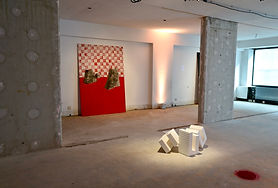
the idea is ‘CAREFULL, taking care of the rough’ - a group exhibition bringing together 6 artists who use raw materials to create delicate works that we admire and take care of. I've always been drawn to the intersection between art, design and architecture; interesting practices that mix artistic disciplines in an uncommon space.
and then I’ve found this quite incredible raw plateau in a modernist building from the sixties overlooking the canal. The space, filled with those geometrical windows, has very few white walls, so it's not a white cube idea but more of a sculptural exhibition filled with installations in an extraordinary uncherished space.
CAREFULL invites us to slow down, notice the textures, and hold space for the unfinished.


huge thanks to
space - Par Asar
sound - Lucimille
textile - Bellerose
drinks - BPM Kollektiv
artists
jean baptiste brueder
studio hermano
yonah taieb
ceji by cha&jean
mehdi görbüz
emily rouvez


THE VOICE OF REBELLION
Performing in Public Spaces as Activism, Belgrade in the 1990’s, the case of ŠKART
Belgrade - London, 2023
"THE VOICE OF REBELLION" is a piece of research focused on art activism's positive impact on citizens during the war. This research focuses on the case of the Yugoslavian war in the '90s and analyses it through the lens of Belgrade-based art collective ŠKART made of Prota and Zole.


RESEARCH
ABSTRACT
We often think that activism must be imposing and noisy, whereas the collective Škart, consisting of Prota and Žole, proved us wrong with their small-scale, abstract and positive activist interventions in Belgrade in the 1990s during the war in former Yugoslavia. The analysis of their philosophy as performers or self-identified poets, as well as their public art actions, led the research towards identifying three strategies used by Škart for their poetic activism. The first one is the collective's autonomy from the art world's expectations of their practice and status as artists. The second is their urge to bring their art pieces to the streets, analysing what it means to be in a public space and the room it leaves for audiences to start dialogues and bridge communities. And the third one is the relationship between ethics and aesthetics. Škart collective believes in the importance of visual identities and abstract activism for the continuity and longevity of their messages and practices. This research is supported by three interviews that provided a considerable amount of exclusive insights by Prota, one of the two members of the Škart collective, Milena Dragičević Šesić, an expert on ex- Yugoslav art activism and Miroslav Karić, curator and author. All three are witnesses and audiences of the time.


thebetatoolkit.net is a digital toolkit created for curators by curators to demystify digital and web curation.
It aims to develop a digital network of creative practitioners and a support system to accompany each other through the processes and challenges of online curating. The toolkit provides practical and theoretical context for the history, representation and contemporary relevance of net.art. The toolkit also brings together tools deemed necessary for the process of curating contributing to the complex journey of navigating the possibilities and challenges of curating online.
It is a collaboration with Arebyte Gallery, the British Art Network and ten interviewees including artists such as Vuk Cosic and Heath Bunting, scholars such as Beryl Graham and Lee Weinberg and important professionals in the net.art field as Nimrod Vardi.


The development of this project required an extensive research process on this emergent art movement, net.art, still quite hardly understandable as it follows its own curatorial rules and can't find itself in the traditional exhibition space as well as being non-tangible. This project has enabled me to understand the accessibility of Internet and its limitations concerning online and digital curation.


This digital curatorial project uncovers the Harambee project through archival material and photographer Colin Jones' "Black House" photography series from London College of Communication's archival collection (LCC). This project was part of Central Saint Martins MA Culture, Criticism and Curation '22 curriculum.
This curatorial project is based on the values of decolonisation and social justice through the change of narratives. We rewrote a page of history that has been implicitly erased.

"In February 2022, a group of students on the MA Culture, Criticism and Curation course at Central Saint Martins, University of the Arts London were given access to a collection of photographs from established photo-journalist Colin Jones.
Part of the collection consists of a series of photographs documenting the residents of Harambee House, a hostel and community project that operated on Holloway Road in North London between 1969 and around 1978. Beyond the photography of Colin Jones, records and information on the Harambee Project are few and far between, and with most other material from the house surviving almost exclusively in archives, these images serve as nearly the only remaining document of Harambee that is easily publicly accessible to date.
Using the Colin Jones collection as a starting point, the group seeks to respond to the project and re-contextualise Harambee House in relation to the voices of those involved at the time through found archival material. Made available to the public through an online platform, this photography has been arranged alongside original artefacts from the house including posters, leaflets, interviews, and letters, all in the hope of re-piecing a clearer history of an important community project that has essentially been erased from Islington history.
It is worth noting that the collection is referred to by Colin Jones as "The Black House", possibly a reference to Michael X's unrelated commune, also on Holloway Road. As the entities are separate - and in the interest of portraying Harambee accurately - we are making the decision to solely refer to the project by its actual name: "Harambee".

The idea behind this curatorial project was to have a website with an "infinite" scroll to invite the users to navigate in the archives as we, curators, have had the chance to. By having archives and images online, we are promoting the accessibility of artworks as much as the stories of individuals. We hope to bring stories and experiences together through an online space, providing a resource for marginalised lived experiences in north London.
We are also inviting anyone who has experiences or insights into the Harambee project to connect with us. We have managed to gather only a fragment of the story, and we want to continue collecting resources and insights to give a clearer and more complete picture of the house as a hostel, as a community centre, and as a point of cultural reference.
TRANSPART exhibition
EXHIBITION
Brussels, September 2021
Ephemeral group exhibition with ten young Brussels-based artists exposing various artworks in a unique location in front of the incredible Abbaye de la Cambre in Brussels, Belgium.




ARTISTS
Elium - Odilon Pain - Brieuc Dufour
Clovis Retif - Zoe Van den Boogaerde
Zohra Scholtes - Mehdi Gorbuz - Hannah Kircher
Garance Brunard - Sophie Weidler-Bauchez
